


Share this article on:
'%3e%3cpath%20d='M0.639648%20-0.000244141H28.2795V27.6396H0.639648V-0.000244141Z'%20fill='black'/%3e%3cpath%20fill-rule='evenodd'%20clip-rule='evenodd'%20d='M11.0067%205.29028H5.12061L12.0994%2014.5084L5.56705%2022.2413H8.58519L13.5259%2016.3926L17.913%2022.1874H23.7991L16.6175%2012.7014L16.6302%2012.7178L22.8136%205.39793H19.7955L15.2035%2010.8338L11.0067%205.29028ZM8.36963%206.90467H10.2021L20.55%2020.573H18.7176L8.36963%206.90467Z'%20fill='white'/%3e%3c/g%3e%3cdefs%3e%3cclipPath%20id='clip0_215_1244'%3e%3crect%20width='27.6398'%20height='27.6398'%20fill='white'%20transform='translate(0.639648)'/%3e%3c/clipPath%3e%3c/defs%3e%3c/svg%3e)

'%3e%3cpath%20d='M0.279785%20-0.000244141H27.9196V27.6396H0.279785'%20fill='black'/%3e%3cpath%20d='M7.94565%209.44696C9.04879%209.44696%209.94306%208.55269%209.94306%207.44956C9.94306%206.34642%209.04879%205.45215%207.94565%205.45215C6.84251%205.45215%205.94824%206.34642%205.94824%207.44956C5.94824%208.55269%206.84251%209.44696%207.94565%209.44696Z'%20fill='white'/%3e%3cpath%20d='M13.4517%2010.4729V21.1617V10.4729ZM7.94531%2010.4729V21.1617V10.4729Z'%20fill='white'/%3e%3cpath%20d='M13.4517%2010.4729V21.1617M7.94531%2010.4729V21.1617'%20stroke='white'%20stroke-width='3.93408'/%3e%3cpath%20d='M15.1792%2015.2236C15.1792%2014.1439%2015.881%2013.0642%2017.1226%2013.0642C18.4182%2013.0642%2018.9041%2014.036%2018.9041%2015.4935V21.1618H22.467V15.0617C22.467%2011.7686%2020.7396%2010.2571%2018.3643%2010.2571C16.5288%2010.2571%2015.6111%2011.2828%2015.1792%2011.9846'%20fill='white'/%3e%3c/g%3e%3cdefs%3e%3cclipPath%20id='clip0_215_1247'%3e%3crect%20width='27.6398'%20height='27.6398'%20fill='white'%20transform='translate(0.279785)'/%3e%3c/clipPath%3e%3c/defs%3e%3c/svg%3e)
Artificial intelligence (AI) has emerged as one of the most transformative technologies of our time. Its applications now span healthcare, agriculture, information technology (IT), software development, education, banking and finance, and beyond.
According to Dr Amani Abou-Zeid, the AU Commissioner for Infrastructure and Energy, Africa’s chances of attaining Agenda 2063 can be catalysed through the strategic use of AI. At the 45th Ordinary Session in Ghana in July 2024, the African Union (AU) Executive Council signalled its intention to ensure that Africa fully benefits from the opportunities associated with artificial intelligence through the AU Continental AI Strategy.
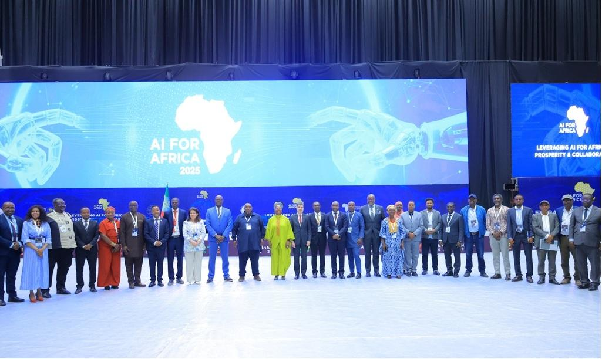
Beyond accelerating the achievement of Agenda 2063 and the Sustainable Development Goals (SDGs), the strategy also seeks to mitigate the risks associated with AI for Africans and promote its responsible integration and adoption across AU member states.
The strategy was developed following input from a wide range of stakeholders, including experts from all 55 AU member states, UNESCO representatives, regional economic communities, and AU specialised institutions. This collaborative effort is reflected in its key pillars, which prioritise African technological growth and youth empowerment.
Key Pillars of the AU Continental AI Strategy
The key pillars of the strategy are as follows:
- Local First – AI development and deployment in Africa must primarily serve and benefit Africans across all sectors.
- People-Centred – AI adoption in Africa should address local challenges using indigenous solutions.
- Acknowledgement of Human Rights – AI use in Africa must uphold human dignity and respect the rights enshrined in the African Charter on Human and Peoples’ Rights, as well as those recognised under international human rights law.
- Wealth Generation – AI systems should support environmental preservation while expanding opportunities for prosperity across the continent.
- Diversity – AI integration must be inclusive and free from discrimination. In particular, it should create meaningful opportunities for African women.
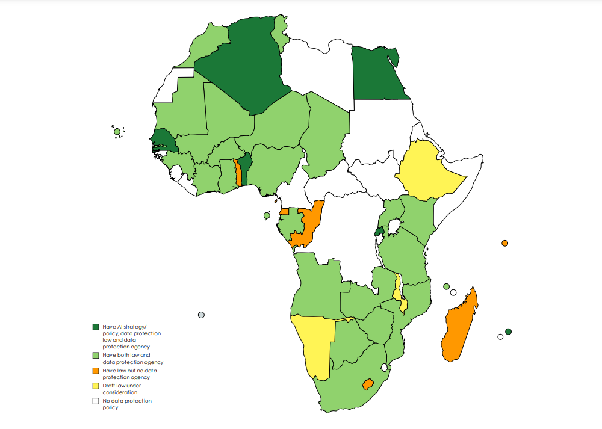
- Ethics and Transparency – The strategy will provide guidance and recommendations to help member states adopt a responsible AI approach. If certain member states or their subsidiaries are concerned about potential effects on culture and identity, marginalisation and segregation will be strongly discouraged. The emphasis on ethical data practices also resonates with ongoing discussions on data governance and privacy in Africa’s digital economy
- Cooperation and Integration – The AU Continental Strategy promotes coordinated governance decisions across regions to foster collective growth within the African ecosystem. Member states and regional bodies are expected to manage and protect data responsibly.
- Skills Development and Public Education – AI initiatives will be supported by formal and informal education programmes to raise awareness and equip Africans with the skills required for an AI-driven future.
These pillars demonstrate that beyond promoting the adoption and expansion of AI in Africa, the strategy also seeks to preserve local values and identity while fostering sustainable growth and development across the continent.
Objectives of the AU Continental AI Strategy
The AU Executive Council outlined specific goals to be achieved before 2030. These objectives reflect both the intent behind the strategy and the outcomes expected from its implementation.
Some of these objectives include:
- Promoting AI adoption among the general public. This involves disseminating accurate information about AI through appropriate channels, including guidance on ethical considerations and safety practices, while addressing common misconceptions. Such efforts aim to enable citizens across African countries to integrate AI responsibly into their personal and professional lives.
- Encouraging the integration of AI within government-supported industries across the continent, particularly in sectors such as agriculture, healthcare, education, climate change, and national security.
- Supporting the adoption of AI by privately owned businesses, including startups and mid-sized enterprises, with a focus on developing AI-powered solutions to address Africa-specific challenges.
- Attracting both public and private investment through research conducted by indigenous institutions.
- Creating and maintaining high-quality datasets and essential infrastructure to support AI development.
- Promoting diversity within Africa’s technology ecosystem, ensuring equal opportunities for young people and women.
Collectively, these objectives are designed to ensure the sustained success of the AU Continental AI Strategy.
Impact of the AU Continental AI Strategy
The AU Continental AI Strategy is scheduled to run from 2025 to 2030 and is structured in three phases. The preparatory phase (Phase 1) took place in 2024. Phase 2 commenced in 2025 and is expected to conclude in 2027.
During this phase, the resources, governance structures, and institutional frameworks needed for effective implementation are established. Phase 3 (2028–2030) will focus on executing major AI integration, development, and deployment projects across African communities.
This phased approach acknowledges the practical challenges of implementation, including aligning public- and private-sector efforts, securing sustainable funding, and establishing governance mechanisms.
Early indicators of the strategy’s influence are already visible within the African tech ecosystem. At the Ethio Tech Expo 2025, D. Matoboge, AU Commissioner for Infrastructure and Energy, noted that over 83% of AI startup funding in the first quarter of 2024 went to Nigeria, Kenya, Egypt, and South Africa. These funded startups operate across diverse sectors, many of which support public service delivery.
The AU Continental AI Strategy represents a significant step toward harnessing artificial intelligence for Africa’s development. By addressing data and infrastructure gaps, ensuring sustainable funding, and maintaining consistent progress monitoring, the AU can translate this strategy into measurable, long-term impact across the continent.
Your next read: What is Digital Sovereignty, and How Are African Countries Approaching It?
Loading, please wait...
Share this article on:
Read latest articles

Paul Ugorji’s on Avoiding the Crowdfarming Trap & Bootstrapping ReapVest
September 06, 2026


Stories of Startups that Escaped the Graveyard
August 28, 2026