Case Study: VMedKit's Early Wager on Virtual Reality Exposure Therapy

Oluwatayo Adeleke
August 10, 2026

Share this article on:
'%3e%3cpath%20d='M0.639648%20-0.000244141H28.2795V27.6396H0.639648V-0.000244141Z'%20fill='black'/%3e%3cpath%20fill-rule='evenodd'%20clip-rule='evenodd'%20d='M11.0067%205.29028H5.12061L12.0994%2014.5084L5.56705%2022.2413H8.58519L13.5259%2016.3926L17.913%2022.1874H23.7991L16.6175%2012.7014L16.6302%2012.7178L22.8136%205.39793H19.7955L15.2035%2010.8338L11.0067%205.29028ZM8.36963%206.90467H10.2021L20.55%2020.573H18.7176L8.36963%206.90467Z'%20fill='white'/%3e%3c/g%3e%3cdefs%3e%3cclipPath%20id='clip0_215_1244'%3e%3crect%20width='27.6398'%20height='27.6398'%20fill='white'%20transform='translate(0.639648)'/%3e%3c/clipPath%3e%3c/defs%3e%3c/svg%3e)

'%3e%3cpath%20d='M0.279785%20-0.000244141H27.9196V27.6396H0.279785'%20fill='black'/%3e%3cpath%20d='M7.94565%209.44696C9.04879%209.44696%209.94306%208.55269%209.94306%207.44956C9.94306%206.34642%209.04879%205.45215%207.94565%205.45215C6.84251%205.45215%205.94824%206.34642%205.94824%207.44956C5.94824%208.55269%206.84251%209.44696%207.94565%209.44696Z'%20fill='white'/%3e%3cpath%20d='M13.4517%2010.4729V21.1617V10.4729ZM7.94531%2010.4729V21.1617V10.4729Z'%20fill='white'/%3e%3cpath%20d='M13.4517%2010.4729V21.1617M7.94531%2010.4729V21.1617'%20stroke='white'%20stroke-width='3.93408'/%3e%3cpath%20d='M15.1792%2015.2236C15.1792%2014.1439%2015.881%2013.0642%2017.1226%2013.0642C18.4182%2013.0642%2018.9041%2014.036%2018.9041%2015.4935V21.1618H22.467V15.0617C22.467%2011.7686%2020.7396%2010.2571%2018.3643%2010.2571C16.5288%2010.2571%2015.6111%2011.2828%2015.1792%2011.9846'%20fill='white'/%3e%3c/g%3e%3cdefs%3e%3cclipPath%20id='clip0_215_1247'%3e%3crect%20width='27.6398'%20height='27.6398'%20fill='white'%20transform='translate(0.279785)'/%3e%3c/clipPath%3e%3c/defs%3e%3c/svg%3e)
Emmanuel Okon graduated from the University of Ibadan in 2016 with a first-class degree in Statistics. He had spent his childhood in a low-income, single-parent household, and had seen mental illness up close before he had language for it. When a scholarship offer to study in Canada arrived, he turned it down and chose instead to build something in Lagos.
In December 2017, Okon began work on VMedKit, alongside co-founder and CTO Philip Igboba and clinical psychologist Feyisetan Oluwatoyosi. Jimoh Saheed and Ridwan Yusuf joined the founding team soon after. The company launched officially in May 2018, positioned as a social enterprise rather than a conventional startup, with a mandate tied explicitly to United Nations Sustainable Development Goal 3’s ensuring healthy lives and promoting wellbeing at all ages. Okon had studied companies like Limbix, a US-based virtual reality therapeutics firm, and asked a simple question. If VR could treat trauma in American clinics, what would it take to bring that same tool to Nigerian patients who had no other path to psychotherapy?
The Clinical Premise
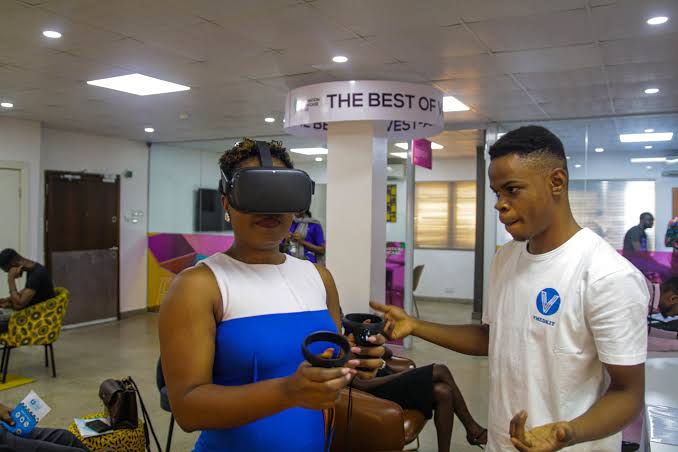
Virtual Reality Exposure Therapy, or VRET, is an alternative form of cognitive-behavioural exposure therapy in which a patient is guided into a simulated environment that resembles the source of their fear or trauma, whether that is a war scene, a site of assault, or a phobia trigger such as heights or enclosed spaces. Under a clinician's supervision, exposure is introduced gradually, often called graduated therapy, so the patient builds tolerance without being retraumatised. The graduated approach is different from flooding, where a patient confronts the full intensity of a trigger at once, as no patient should be exposed to a scenario they had not consented to and understood.
Why virtual reality works here, in exposure therapy, is the need for access to environments that would be impractical or unsafe to recreate physically. A therapist in Lagos cannot easily reconstruct a combat zone or a flooded building for a patient in exposure therapy. A headset can approximate one. VMedKit built its own content library toward this end, aimed at PTSD, phobias, and anxiety disorders, and later expanded its framing to include depression and bipolar disorder support, positioning VR as a tool for relaxation and psychoeducation as well as exposure.
Building the Model
VMedKit adopted a B2B structure rather than selling directly to individual patients. Its early clients included Federal Neuro-Psychiatric Hospital, Yaba, University of Abuja Teaching Hospital, and the Patrick Speech and Languages Centre – Nigeria’s first autism centre, with its broader pitch extending to corporate wellness, positioning VR-based mental health support as an employee benefit for Nigerian workplaces. By late 2019, the company said it had reached more than 500 people since entering the market, with a team of 6 full-time and 8 part-time staff.
Early capital came in small, credibility-building amounts rather than venture-scale rounds; Company Africa awarded VMedKit a 20,000-dollar grant in January 2018, and the Tony Elumelu Foundation added a 5,000-dollar grant shortly after. The World Health Organisation named Okon a Mental Health Expert, Microsoft and First Bank Nigeria recognised him for innovation in AI and big data, and he partnered with the Lagos State Employment Trust Fund (LSETF) on a separate security-focused project. Each qualification validated the company to healthcare providers and funders who had no established framework to evaluate VR healthcare startups.
The Facebook Accelerator Chapter
VMedKit's clearest validation came in 2019, when it was selected for the second cohort of the FbStart Accelerator, known locally as Facebook Accelerator Nigeria, run in partnership with Co-Creation Hub. The programme was the first deep tech acceleration initiative of its kind in the region, and it had expanded that year to accept applicants from Ghana as well as Nigeria. VMedKit was one of eight startup teams selected, alongside ventures such as Curacel, Appruve, and Chekkit Technologies, out of a pool that also included four student teams. Selected startups received 20,000 dollars in equity-free funding and access to a six-month programme built around mentorship and product guidance from Facebook and CcHUB's networks.
The same year, Okon was named a finalist for the Anzisha Prize, which recognises Africa's most promising young entrepreneurs between the ages of 15 and 22, and he became a fellow of Yunus & Youth, a global social business fellowship. On paper, by the end of 2019, VMedKit had assembled the markers most African health-tech founders spend years chasing: a Facebook-backed accelerator credit, foundation grants, hospital contracts, and international fellowship recognition, all before the founder turned 23.
Where the Model Met Resistance
Unfortunately, institutional validation and commercial durability are two different things. Underneath the accolades, several frictions began to emerge.
The first was hardware. VRET depends on headsets that were, in 2018 and 2019, still expensive relative to Nigerian purchasing power and difficult to source locally, since most were imported and priced in foreign currency during a period of naira volatility. A hospital or clinic could not simply add a VR headset to its equipment budget the way it might add a blood pressure monitor. This made VMedKit's B2B sales cycle inherently slow, since each new hospital relationship required convincing a budget holder to invest in unfamiliar equipment for a therapy most Nigerian clinicians had never been trained to administer.
The second was the absence of a reimbursement pathway. Nigeria's health insurance penetration remains low, and HMOs had no existing claims code or clinical protocol for VR-based exposure therapy. Without insurance coverage, the cost of a VRET session had to be absorbed either by the patient, the employer, or the hospital itself, none of which had a strong incentive to prioritise it over more established interventions.
The third was clinical workforce capacity. Nigeria has one of the lowest ratios of psychiatrists to population in the world, and the clinicians who did exist were not trained in VR-assisted protocols. VMedKit was not only selling a device. It was asking hospitals to adopt a new clinical workflow inside a system already short of the specialists who would need to run it.
The fourth was timing at the level of the broader VR market. Consumer VR hardware in 2018 and 2019 was still finding its footing globally, well before standalone headsets became affordable and widely available. A Nigerian health-tech company building on top of an immature global hardware category absorbed two sets of adoption risk at once: the risk of a new clinical modality, and the risk of an underlying technology still unsettled.
The Quiet Unwind
VMedKit's public trail, dense through 2019, markedly thinned afterwards. There was no public statement from the company announcing a closure. However, a visible pattern common to many early African health-tech ventures that do not raise a follow-on round - press coverage, social activity, and public programming cluster tightly around the accelerator, an award cycle, then fade - was visible. By late 2023, Okon's own public professional record shows him working as a frontend engineer for an unrelated company, based in Kigali rather than Lagos, a trajectory more consistent with a founder who has moved on.
The likely account is one of a slow runway erosion against a market that was not yet ready to absorb the product at the pace a small team could sustain. Grant funding and accelerator support could only get the venture to a first proof point, not carry it through years of hospital procurement cycles, clinician retraining, and hardware cost curves outside the founders' control.
Key takeaways
Frontier technology can be globally validated and still fail to sell if the institutions meant to buy it lack the budget, training, or reimbursement structure to use it, as clinical validation and distribution are separate problems. VMedKit's client list highlights the pattern: novel clinical technology in Nigeria moves through direct relationship and pilot programme, not through a market that pulls innovation in on its own, and that reality should shape how any new vendor plans its first 18 months.
Also, equity-free funding and mentorship buy early credibility, but credibility is not infrastructure. An accelerator credit can open doors founders could not open alone, but it cannot manufacture affordable hardware, train psychiatrists, or create an insurance code where none exists.
Nigeria’s digital therapeutics environment has since shifted; falling hardware costs, wider mental health awareness, expanding telehealth, and growing interest make today's conditions more receptive to immersive healthcare than 2018 was, even if the path remains far from easy.
VMedKit’s attempt at introducing virtual reality into Nigerian psychotherapy before immersive healthcare became part of mainstream digital health conversations was an uncommon feat. Though the company ultimately disappeared, its significance extends beyond its lifespan, as it demonstrated what was possible.
Loading, please wait...
Share this article on:
Related quiz
Case Study
Quiz: VMedKit’s Early Wager on Virtual Reality Exposure Therapy
Test your knowledge of VMedKit's VR therapy model, market challenges, and the dynamics of early African digital health ventures.
Read latest articles

Paul Ugorji’s on Avoiding the Crowdfarming Trap & Bootstrapping ReapVest
September 06, 2026


Stories of Startups that Escaped the Graveyard
August 28, 2026