

Share this article on:
'%3e%3cpath%20d='M0.639648%20-0.000244141H28.2795V27.6396H0.639648V-0.000244141Z'%20fill='black'/%3e%3cpath%20fill-rule='evenodd'%20clip-rule='evenodd'%20d='M11.0067%205.29028H5.12061L12.0994%2014.5084L5.56705%2022.2413H8.58519L13.5259%2016.3926L17.913%2022.1874H23.7991L16.6175%2012.7014L16.6302%2012.7178L22.8136%205.39793H19.7955L15.2035%2010.8338L11.0067%205.29028ZM8.36963%206.90467H10.2021L20.55%2020.573H18.7176L8.36963%206.90467Z'%20fill='white'/%3e%3c/g%3e%3cdefs%3e%3cclipPath%20id='clip0_215_1244'%3e%3crect%20width='27.6398'%20height='27.6398'%20fill='white'%20transform='translate(0.639648)'/%3e%3c/clipPath%3e%3c/defs%3e%3c/svg%3e)

'%3e%3cpath%20d='M0.279785%20-0.000244141H27.9196V27.6396H0.279785'%20fill='black'/%3e%3cpath%20d='M7.94565%209.44696C9.04879%209.44696%209.94306%208.55269%209.94306%207.44956C9.94306%206.34642%209.04879%205.45215%207.94565%205.45215C6.84251%205.45215%205.94824%206.34642%205.94824%207.44956C5.94824%208.55269%206.84251%209.44696%207.94565%209.44696Z'%20fill='white'/%3e%3cpath%20d='M13.4517%2010.4729V21.1617V10.4729ZM7.94531%2010.4729V21.1617V10.4729Z'%20fill='white'/%3e%3cpath%20d='M13.4517%2010.4729V21.1617M7.94531%2010.4729V21.1617'%20stroke='white'%20stroke-width='3.93408'/%3e%3cpath%20d='M15.1792%2015.2236C15.1792%2014.1439%2015.881%2013.0642%2017.1226%2013.0642C18.4182%2013.0642%2018.9041%2014.036%2018.9041%2015.4935V21.1618H22.467V15.0617C22.467%2011.7686%2020.7396%2010.2571%2018.3643%2010.2571C16.5288%2010.2571%2015.6111%2011.2828%2015.1792%2011.9846'%20fill='white'/%3e%3c/g%3e%3cdefs%3e%3cclipPath%20id='clip0_215_1247'%3e%3crect%20width='27.6398'%20height='27.6398'%20fill='white'%20transform='translate(0.279785)'/%3e%3c/clipPath%3e%3c/defs%3e%3c/svg%3e)
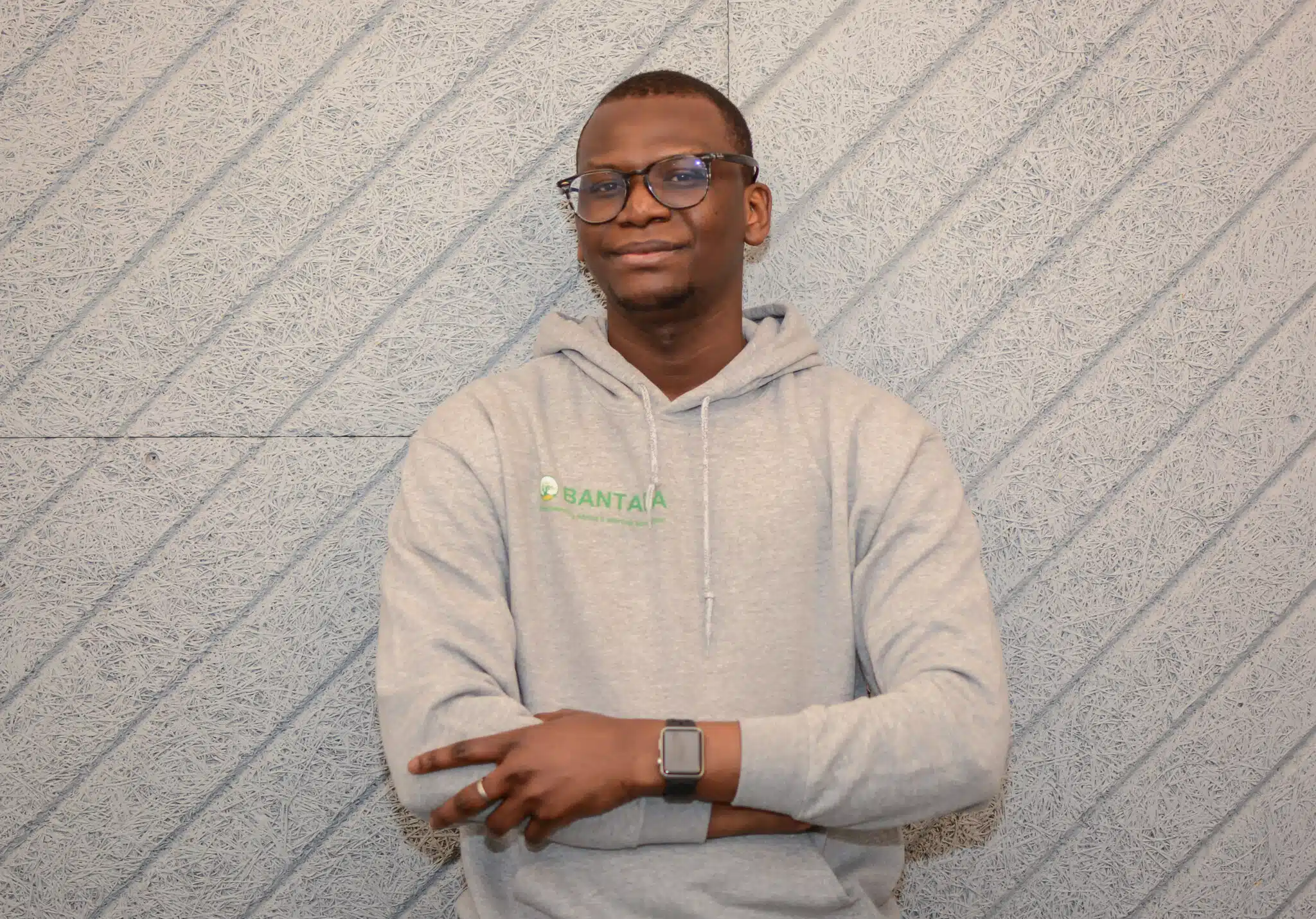
In late 2025, I sat down with Lamin K Darboe, the founder of Bantaba, for a candid conversation about the reality of building tech companies for the African continent. At the time, the ecosystem was navigating a profound, overdue structural reset. The easy-equity boom of 2021 was firmly in the rearview mirror, replaced by a macro-environment that forced founders to ruthlessly audit how sustainable value is actually created.
Lamin’s personal trajectory—moving from building Bantaba (a community marketplace designed to connect diaspora talent and capital with African founders) to launching PitchWise (a specialised B2B software infrastructure tool for fundraising analytics)—is an isolated pivot on paper. But in reality, it serves as a perfect microcosm of where African tech stands today.
The era of building flashy, asset-light storefronts has yielded to the hard, unglamorous work of building the infrastructure engine room.
Satiating the "Y" Areas, Starving for the "X"
To map out why B2B software infrastructure is dominating current operational strategies, we have to look at how innovation has scaled across the continent over the last decade. Ecosystem research, notably detailed in TechCabal’s macro reports, helpfully categorises African commerce into two distinct operating layers: "Y Areas" and "X Areas".
The "Y" Areas: These represent the consumer-facing, highly visible elements of tech. Think basic digital storefronts, B2C marketplaces, standard peer-to-peer payment wallets, and last-mile consumer delivery apps. Between 2019 and 2022, international venture equity flooded these spaces, leading to extreme saturation and fragile unit economics.
The "X" Areas: These are the back-end operational frameworks. They represent the deep structural gaps that have historically choked small and medium enterprises (SMEs)—regulatory compliance, supply chain logistics, localised risk assessment, and the conversion of raw transaction data into actionable data intelligence.
Lamin’s original venture, Bantaba, was anchored in a "Y Area." It relied on a classic community marketplace framework: aggregating diaspora goodwill on one side and matching it with African founders on the other. But as Lamin openly analysed during our conversation, loose community matchmaking inevitably collides with a structural wall. The diaspora did not expect immediate financial equity; the cash-constrained founders lacked the capital to pay for premium advisory, and engagement fell off because the platform lacked the transactional rails to enforce operational value.
Goodwill does not scale on its own. Structural infrastructure does.
The Architecture of the Trust Gap
When the global capital environment corrected, investors stopped funding bold, unvalidated visions. Data from major ecosystem trackers such as Partech Africa confirm a massive flight toward structural resilience. Venture debt financing on the continent reached a record $1.64 billion, shifting from a marginal complement to a permanent structural layer that accounts for 41% of all tech capital deployed. Concurrently, enterprise software and B2B infrastructure verticals achieved clear structural traction, surging 74% year-on-year to cross $274 million in annual equity funding.
Lenders and VCs are still writing checks, but they are obsessed with clear data room metrics, governance, and verifiable unit economics.
This reality brings us to the core thesis behind Lamin’s shift to PitchWise and the primary bottleneck of cross-border African business scaling: information asymmetry.
"Private company data across the African continent is notoriously fragmented, opaque, and inconsistent. This information asymmetry breeds a deep, systemic trust gap between local founders and global capital."
When a founder pitches an investor in a mature Western ecosystem, a deep framework of public infrastructure, credit registries, and corporate histories exists to automatically close the information gap. In Africa, that foundational layer is historically missing. Every deal requires an exhausting, highly manual due diligence loop because data transparency is rare.
PitchWise addresses this specific bottleneck by turning the fundraising process from a relational "black box" into a verifiable data science process. By providing slide-by-slide view metrics, tracking exact investor viewing times, and enabling automated email data-gating, the software shifts the power dynamic. It allows a founder to see exactly where an investor disengages (for instance, identifying that 80% of VCs drop off at slide six), giving them the technical intelligence to fix structural narrative flaws before wasting cycles on dead leads.
Moving From Platforms to Intelligent Rails
This pivot toward deep operational infrastructure mirrors a broader, continent-wide mandate. Winning African software companies are no longer aiming to build sprawling, asset-light consumer networks; they are building the intelligent, backend rails that drastically reduce operational time lags and friction.
We see this playing out decisively across core sectors:
Fintech & Enterprise Software: Moving away from standard consumer wallets toward complex B2B infrastructure, cross-border stablecoin payments corridors, and embedded invoicing suites that convert basic transactional flows into predictable business intelligence.
Agritech: Moving past basic inputs-and-credit marketplaces toward deep, climate-modelled backend engines. Companies are actively integrating AI and satellite data models to provide precise, predictive soil and weather metrics, reducing structural default risks for agricultural lenders.
Logistics & Clean Energy Infrastructure: A massive capital reallocation toward tangible, asset-heavy infrastructure. Clean energy financing and solar grid systems nearly doubled in funding to over $1.18 billion, proving that Africa's most fundable software is that which optimises physical and operational infrastructure.
The New Playbook for Sustainable Scale
The insights Lamin shared highlight an uncompromising reality that defines entrepreneurship today: the "growth at all costs" era is officially dead. The old playbook of blitzscaling a consumer app to a foreign IPO has been replaced by an aggressive focus on unit economics, regional consolidation via strategic M&A, and software specifically engineered to solve localised friction.
Building enterprise B2B infrastructure isn’t as flashy as launching a consumer platform that goes viral on social media. It requires treating complex regulatory constraints, fragmented markets, and harsh physical realities as design parameters.
But as the macroeconomic data reveals, the engine room is where the real value is being captured. By replacing fuzzy community networks with solid analytical infrastructure and mitigating information asymmetry, founders are building an ecosystem that doesn't just raise capital—but actually sustains it.
Loading, please wait...
Share this article on:
Read latest articles

Meditell: The Startup that Arrived Too Early
June 22, 2026

How the 2015/2016 Class Rewrote African Fintech
June 15, 2026

The Hidden Cost of the 2021–2022 Mega-Round Boom
June 08, 2026